21 October 2026
Your guide to road signs in Ireland (2026)
10 minutes
|
Road signs are a fundamental part of driving in Ireland. Whether you're preparing for your driving test, or simply brushing up on the rules of the road, understanding what different signs mean can help you stay safe and drive with confidence.
In this guide, we'll break down the different types of road signs you'll encounter in Ireland, what they mean and how to identify them. We'll also cover signs that often confuse drivers, and practical tips for learners.
What's covered:
Looking for learner driver insurance? Get in touch with us! A member of the Howden team would love to help |
Overview: the 4 main categories of road signs in Ireland
Irish road traffic signs fall into four core categories:
Regulatory signs - rules that road users must follow.
Warning signs - alerts road users to hazards ahead
Information signs - provide directions, distances and other useful travel information.
Motorway signs - give directions, regulations, and information specifically for motorways
The table below summarises how to recognise each type at a glance:
Colour | Sign category | Meaning |
|---|---|---|
Yellow | Warning | Warning - hazard ahead |
Red | Regulatory | Prohibition, restriction, or danger |
Blue | Regulatory; Motorway | Mandatory instruction or motorway information |
Green | Informational | National road directions |
White | Informational; Regulatory | Local road directions or regulations (with red border) |
Brown | Informational | Tourist and heritage attractions |
Orange | Warning | Roadworks warning |
Regulatory road signs: rules you must follow
Regulatory signs are mandatory instructions that you must follow by law. Regulatory signs help keep traffic flowing safely and in order.
There are generally two types of regulatory signs:
Prohibitory: Circular with a red border - indicating forbidden actions
Mandatory: Circular with blue background - indicating required actions
The two key exceptions to this are:
STOP: Come to a complete stop
YIELD: Give way to oncoming traffic
Tip: these are the two most important regulatory signs, so make sure you're familiar with them. They frequently appear in the theory test and are closely monitored during the practical driving test.
Speed limit signs
Speed limit signs in Ireland are circular with a red border and white background. The number inside shows the maximum legal speed limit in kilometres per hour (km/h). Drivers should travel below the limit whenever road, traffic, or weather conditions require it.
30 km/h – Residential areas
50 km/h – Town and city roads
60 km/h – Regional roads
80 km/h – Non-national / standard rural roads
100 km/h – National roads
120 km/h – Motorways
Prohibitory sign examples:
Speed limit signs
No entry / No straight ahead
Stop
Yield
No overtaking
Height restriction
Maximum gross weight

Mandatory sign examples:
Turn left/right ahead
Keep left/right
Straight ahead
Pass either side
Mini roundabout
Warning road signs: hazards and changes ahead
Warning signs are diamond shaped with a black border. They are either yellow for permanent hazards or orange for temporary roadworks.
Warning signs alert drivers to upcoming hazards or dangers ahead and require caution. Unlike regulatory signs, they don't give orders. Instead, they alert you to hazards or changing road conditions ahead, giving you time to adjust your speed and position safely. Always slow down and stay alert when you see one.

General warning signs
General warning signs highlight a wide variety of road hazards, including sharp bends, junctions ahead, pedestrian crossings, and road narrowing.
These signs regularly appear in the RSA Driver Theory Test, so make sure you know them!
Examples include:
Dangerous bend ahead
Dangerous corner ahead
Series of bends ahead
Roundabout ahead
Pedestrian crossing ahead
School ahead
Railway crossing ahead
Slippery road
Steep descent or ascent
Road narrows on both sides
Road narrows left
Road narrows right
Animal crossing
Low bridge ahead
Tram lane
Junction warning signs
Junction warning signs alert drivers to the type of junction ahead, giving you time to adjust your speed, select the correct road position, and prepare safely before reaching it. Examples include:
Crossroads
Staggered crossroads
T-junction
Y-Junction
Side road
Merging traffic
Roundabout ahead
Roadwork signs
Roadwork signs warn drivers about temporary hazards caused by maintenance or construction works. They often appear alongside temporary speed limits, lane restrictions, and diversion routes. They have an orange background instead of yellow to distinguish them from permanent warning signs. Examples include:
Road works ahead
Road closed
Detour ahead
Two way traffic signs
Temporary speed limit signs
Lane closed ahead
Loose chippings
Uneven road surface
Information road signs: directions, services and tourist routes
Information signs help road users navigate by providing directions, distances, and information about nearby destinations and services. They identify towns, cities and villages, as well as public facilities, tourist attractions, and other locations of interest. They do not impose legal requirements. They are normally rectangular and use colour coding to indicate different road types:
Blue - Motorways
Green - National roads
White - Local roads
Brown - Tourist and heritage attractions

Examples of information signs:
Direction signs: for motorways, national and regional roads
City, town or village sign
Distance signs
Parking signs
Hospital signs
Airport signs
Tourist attraction signs
With flow bus lane
Contra flow bus lane
Motorway signs in Ireland
Motorway signs indicate when you are entering, travelling on, or leaving a motorway. They also provide advance notice of upcoming exits. Motorway signs are rectangular with a blue background and white text.
Examples of motorway signs:
Motorway ahead
Entry to motorway
End of motorway
Junction and exit signs
Countdown markers: 100m, 200m, 300m to next exit
Motorway service area
Motorway toll charges

Motorway rules to remember:
You cannot drive on the motorway with a learner permit unless accompanied by an RSA-approved driving instructor.
The maximum speed limit is 120 km/h on Irish motorways.
Only use the hard shoulder in an emergency, breakdown, or when directed by a Garda.
Never perform a U-turn on a motorway, as this is prohibited and extremely dangerous.
Road markings in Ireland
As with road signs, road markings play a vital role in road safety and traffic management across Ireland. They provide instructions, reinforce road signs, indicate right of way, and help road users understand when they can stop, park, overtake, or cross.
Common Irish Road Markings Explained
Solid White Lines: These lines should not be crossed except when necessary for safety reasons or in an emergency.
Broken White Lines: You may cross these lines when it is safe to do so, such as when overtaking.
Double Yellow Lines: Parking is prohibited at all times unless a specific exemption applies.
Single Yellow Lines: Parking restrictions apply during the times shown on nearby signs.
Zebra Crossings: These mark designated pedestrian crossing points. Drivers must give way to pedestrians who are crossing or waiting to cross.
Yellow Box Junctions: Enter the box only if your exit route is clear. Stopping within the box can obstruct traffic and may result in a penalty.
Remember: Road markings are legally enforceable and should be treated with the same importance as road traffic signs.
7 Irish road signs that catch drivers out
Even experienced drivers misread certain signs. Here are 7 of the most commonly confused road traffic signs and how to respond correctly:
Yellow box junctions - If traffic ahead is not moving, stay behind the box until you can clear it completely. Stopping in the box because of stationary traffic ahead is an offence and a common driving test fault. Many driving test routes will feature yellow box junctions.
STOP signs - even when the road appears clear, you need to come to a complete stop. Failing to stop properly at a STOP sign can result in an immediate driving test failure.
Default speed limits - Remember, speed limits still apply even when no sign is visible. Learners should know the default limits for built-up areas, rural roads, national roads and motorways, and always watch for signs indicating a change.
Dangerous corners vs. Dangerous bends - These two types of signs are often confused. A dangerous corner warns of a sharp change in direction, whereas a dangerous bend indicates a sweeping curve. In both cases, slow down early and avoid leaving your braking until the last moment.
Crossroads vs. T-junctions - Remember that a T-junction means your road is ending and you must give way, while a crossroads sign indicates an upcoming intersection where traffic may approach from multiple directions. Priority depends on the markings at the junction.
Bus lane and contra flow bus lane signs - Drivers often ignore time plates showing operating hours. Outside those hours you may use the lane; during them, stay out unless turning left where permitted.
Amber traffic lights - Amber means stop unless you are already too close to the stop line to do so safely. They do not mean "speed up before it turns red." As soon as a traffic light turns amber, slow down to a stop.
Tips for learners: Road signs in the Irish driving test
Road signs form a key part of both the theory test and the practical driving test. Make sure you know them well before test day.
Road signs in the RSA theory test
Expect plenty of road sign questions in the RSA Driver Theory Test. You'll need to identify signs by their shape, colour and symbol, then select the correct driver response. The test is multiple choice and taken on a computer at a Road Safety Authority-approved centre.
Theory test tip: Memorise road signs one category at a time rather than cramming the whole lot in one go. More often than not, a sign's shape and colour will point you towards the answer before you've even looked at the symbol.
Road signs in the practical driving test
At the beginning of your practical driving test, your examiner will ask you technical questions about the rules of the road, including road signs. You'll then drive across a range of road and traffic conditions, while the examiner assesses your practical skills. They will be checking whether you read and respond to road signs correctly.
Key road signs to know before your test:
All common speed limit signs
STOP and YIELD signs with corresponding road markings.
No entry, no right/left turn, and one-way signs.
Bus lanes and cycle lane signs.
Warning signs for dangerous bend ahead, dangerous corners, road narrows, narrows on both sides, and pedestrian/school crossings.
Yellow box junctions
Mandatory turn signs
Looking for learner driver insurance? Get in touch with us! A member of the Howden team would love to help |
Resources for learners
Below is a list of helpful resources to help you prepare for test day:
Sources:
This is a marketing article from Howden Insurance. The information in this guide is accurate at time of publication. This content is provided for general information only and does not constitute financial or insurance advice.
Road signs Ireland: FAQs
What are the most common road signs in Ireland?
The most common road signs in Ireland include speed limit signs, stop signs, yield signs, no-entry signs, warning signs for bends and junctions, and directional information signs. These signs help drivers follow road rules, identify hazards ahead, and navigate safely on Irish roads.
What are the four road sign categories in Ireland?
The four road sign categories in Ireland are regulatory signs, warning signs, information signs, and motorway signs. Regulatory signs display legal requirements and restrictions, warning signs highlight potential hazards, information signs provide directions and services, and motorway signs guide drivers on motorways and major routes.
Are Irish road signs different from the UK?
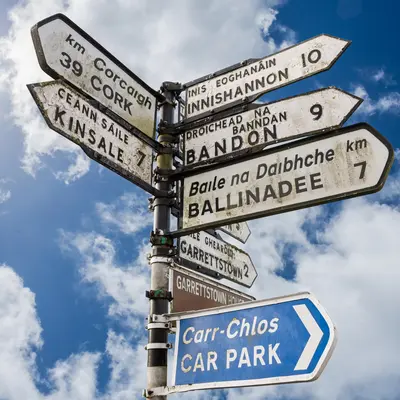
Yes, Irish road signs differ from UK road signs in many ways. For example, Ireland uses kilometres per hour (km/h) rather than miles per hour (mph), warning signs are yellow diamonds instead of red-bordered triangles, and many signs are bilingual.
Do Irish road signs use both Irish and English languages?
Yes, many road signs in Ireland are bilingual and display text in both Irish and English. In Gaeltacht regions, where Irish is the primary language, signs may be shown in Irish only.
What are brown traffic signs used for in Ireland?
Brown traffic signs in Ireland are used for tourism and visitor information. They direct road users to attractions, heritage sites, and services.
More resources
Latest insurance guides
Whether you're looking for information on car, home, travel, life, or health insurance, we've got you covered with expert insights and easy-to-follow guides. Explore our articles to make informed decisions and safeguard your future with confidence.
Related Products
Helping to save you money, without compromising on cover. We listen to your needs and help find the policy that’s right for you — at our best possible price.
Our team can help learner drivers find the best car insurance policies for them.
We can help you build a car insurance plan which not only provides comprehensive cover for you, but also suits your budget.
Don’t be left stranded. Get your hands on breakdown cover that responds when you need it most.